


17
JulHow to Organize a Canadian Work Permit Application
An evidence-control workflow for a Canadian work permit file
How to Organize a Canadian Work Permit Application
Short answer. First identify the exact work-permit pathway and where the person is legally permitted to apply. Retrieve the current IRCC instructions and personalized document list for that situation. Then organize identity, status, work basis, personal history and conditional evidence so every name, date and fact agrees. Stop before submission if eligibility, status, admissibility, a refusal, a deadline or a material inconsistency is unresolved.
A controlled file connects the correct pathway and current IRCC instructions to consistent evidence and a final submission check.
Legal information notice. This is general organizational information, not legal advice and not a determination that anyone is eligible. Immigration rules, forms, portals and instructions change. Check current official IRCC instructions for the exact situation and obtain individual advice from an authorized Canadian immigration professional when needed.
1. Identify the exact pathway and where to apply
“A Canadian work permit” is not one application. A person may be considering an employer-specific permit or an open permit, and the rules can differ for an application made outside Canada, inside Canada or in a limited port-of-entry situation. Do not choose a route because another applicant used it.
Start at IRCC's current work in Canada hub. Record the proposed permit type, program or exemption basis, current location, citizenship, Canadian status if any, job and employer facts, family situation and intended timing. These facts are inputs for legal analysis, not proof of eligibility.
Stop: obtain individual advice before proceeding if the person's right to apply from a location, current status, restoration issue, work authorization, job basis or deadline is unclear. Filing the wrong application can have consequences that a document checklist cannot repair.
2. Save the current official instructions and document list
Create a source register with the IRCC page URL, page title, access date and the pathway fact it controls. Use the current online questionnaire or portal process where applicable to generate the applicant's document list. Also check country- or visa-office-specific instructions and special program requirements.
IRCC's current page for forms and documents for applications outside Canada illustrates why one universal blog checklist is unsafe: the forms, local office requirements, employment evidence and supporting documents depend on the situation. An inside-Canada application or another pathway needs its own current instructions.
Create a dated PDF or screenshot record for internal control, but return to the live official source before submission. Mark older downloaded forms “superseded” instead of mixing them with the active file.
3. Build an identity, travel and status folder
Use the current IRCC list to gather the exact identity and travel evidence required. Create an index that records the document type, holder's name, number only in a secure system, issue and expiry dates, issuing authority, pages included and translation status. Never publish or send sensitive documents through an unsecured channel.
Compare spelling, order of names, dates and places of birth across passports, prior permits, civil records and forms. Document legitimate differences instead of silently choosing one version. If a passport will expire soon, ask how that affects the application and possible permit validity; do not infer the answer.
For a person in Canada, separate proof of current status, any pending application and the last date of authorized stay. Status and maintained-status questions can be legally significant. Pause for advice rather than relying on an online anecdote.
4. Document the claimed work-permit basis
Employer-specific and open work permits use different legal and evidentiary foundations. For an employer-specific route, the file may involve an LMIA, an LMIA-exempt offer number, job offer, contract and evidence that the applicant can perform the work. For an open permit, the file must establish the exact open-permit category. Which evidence applies must come from current IRCC instructions and the facts.
Create a work-basis summary that maps each material statement to a source document: employer legal name, job title, duties, location, wage, hours, start date, duration, program number and occupational classification where applicable. The summary is a quality-control tool, not a substitute for evidence.
Rathod Law Firm publishes a work permit service route and a broader immigration applications route. These pages identify service categories only. Verify the professional, authorization, jurisdiction, engagement scope and advice before relying on representation.
5. Align personal, education and employment history
Build a chronological table covering addresses, education, employment, unemployment, travel and immigration history for every period requested by the current forms. Use source records such as prior applications, permits, resumes, employer letters and travel documents. Flag gaps and overlaps for explanation.
Do not edit facts merely to make the history look cleaner. A difference between a resume, employer letter and prior immigration application may be innocent, but it should be understood before submission. Material misrepresentation can carry serious consequences. Seek legal advice if an answer is uncertain, a prior filing appears inaccurate or a fact may affect admissibility.
Keep family information consistent across the principal applicant and accompanying or non-accompanying family records. Confirm definitions from current official instructions rather than everyday language.
6. Control translations, certifications and file quality
Check the current IRCC rules for documents not in English or French, including who may translate, whether an affidavit or certified copy is needed and how the original-language document must be provided. Do not assume a bilingual friend or machine translation satisfies the requirement.
Name files consistently, for example by section, document and person, without exposing sensitive identifiers. Confirm that every scan is complete, upright, legible and within portal limits. Multi-page records should be in the required order. Preserve the source file and a checksum or version log when several people are editing.
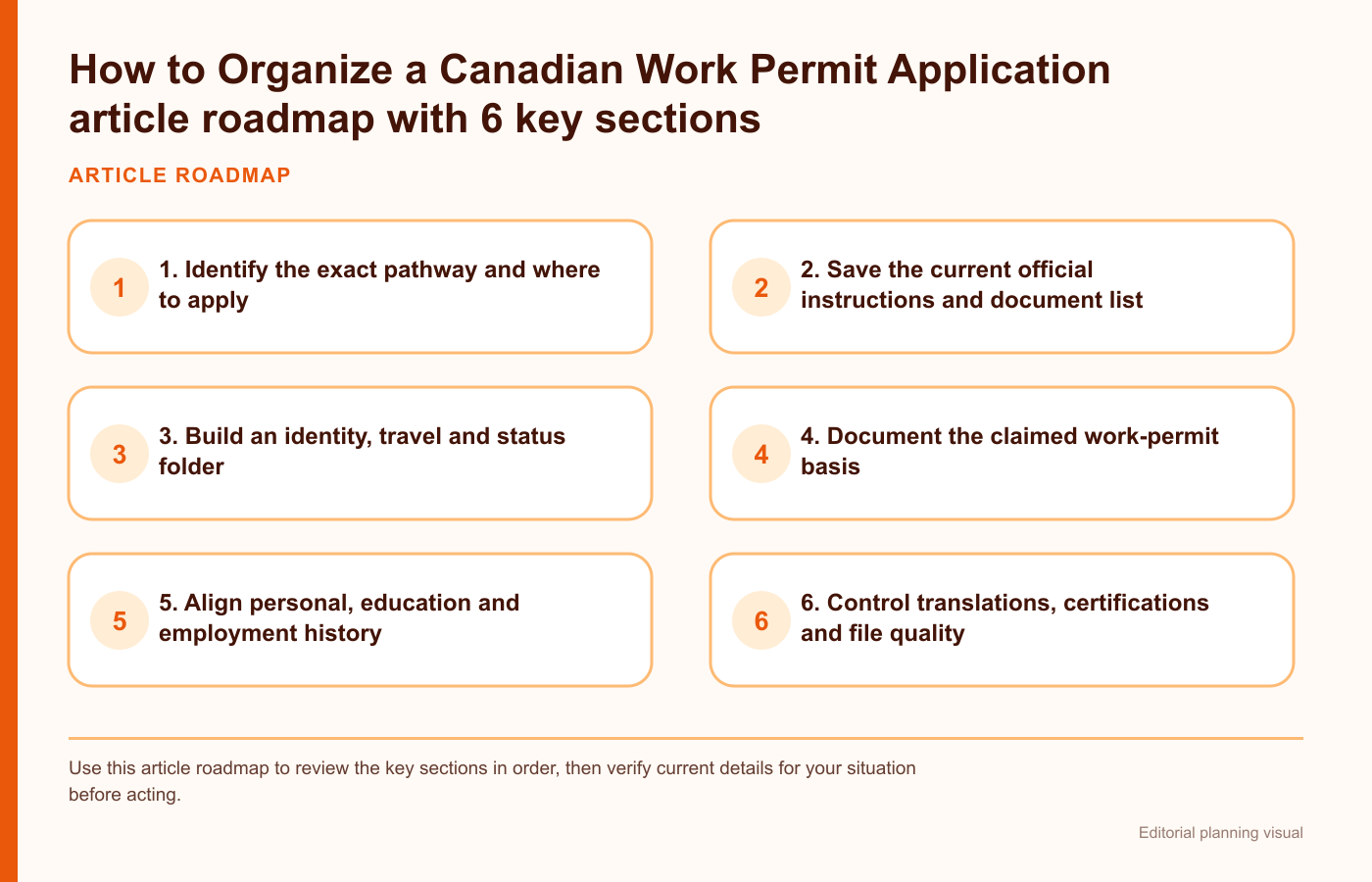
Use this article roadmap to review the key sections in order, then verify current details for your situation before acting.
7. Resolve biometrics, medical, police and local requirements
Some applicants may need biometrics, a medical examination, police information, a temporary resident visa or electronic travel authorization, or additional visa-office evidence. Whether and when these apply depends on current instructions and personal facts. Do not book an unauthorized examination or omit a requirement because another applicant did not receive it.
Create a conditional-requirements table with four columns: issue, official source, current status and next action. Include family members where relevant. Keep instruction letters and receipts in the file, and track deadlines exactly as communicated by IRCC.
8. Complete the current forms and portal fields
Open forms from the live official link, verify the version and follow the current validation, signature and submission instructions. Copy facts from the controlled evidence table rather than memory. If a field cannot hold the full answer, use the method permitted by the current instructions; do not invent abbreviations that change meaning.
Review fees only on the live IRCC page for the exact application immediately before payment. Fees and exemptions can change, so this article intentionally does not freeze amounts. Use the official payment route and preserve the receipt.
Before upload, confirm each portal slot contains the correct final file, not a draft or another person's record. A portal label is not proof that the underlying document is complete.
9. Run a fact-by-fact consistency review
| Review area | Compare | Stop condition |
|---|---|---|
| Identity | Names, birth facts, passport and civil records | Unexplained material difference |
| Status | Entries, permits, applications and deadlines | Unclear legal status or filing location |
| Work basis | Offer, program basis, duties and employer records | Missing or contradictory foundation |
| History | Forms, resume, prior applications and travel | Gap, false answer or unresolved refusal |
| Documents | Checklist, translations, versions and signatures | Missing required item or obsolete form |
| Submission | Portal uploads, fees and declarations | Wrong file or unreviewed declaration |
Have the applicant review every declaration personally, even when a representative or helper prepared the file. IRCC says applicants remain responsible for the information in their applications.
10. Submit, preserve proof and manage updates
Submit only through the current authorized channel for the pathway. Save the complete final forms, uploaded evidence, payment receipt, confirmation page and submission timestamp. Record which version was filed. Do not keep the only copy inside a portal account.
After submission, follow current IRCC instructions for biometrics, additional document requests, changes in circumstances, passport updates and status checks. Processing-time tools are estimates, not promises. Do not make irreversible work, travel or employment decisions based only on an estimated date.
If IRCC requests information, record the exact request, deadline, response scope and delivery confirmation. Seek legal advice when a request touches admissibility, credibility, misrepresentation, a refusal concern or a fact that changed after filing.
Work permit application file mistakes to avoid
- Using a friend's pathway or checklist
- Applying from a location without confirming permission to do so
- Mixing old forms with current portal instructions
- Leaving unexplained gaps or conflicting dates
- Treating a job offer as automatic work-permit eligibility
- Uploading incomplete, unreadable or incorrectly translated evidence
- Paying through a non-official route or trusting a guaranteed approval
- Submitting before resolving status, refusal or misrepresentation concerns
- Failing to save the exact submitted record and receipt
Frequently asked questions
Is there one Canadian work permit checklist?
No. The actual list depends on permit type, application location, country instructions and personal facts. Use the current IRCC process for the exact situation.
Does hiring a representative improve the chance of approval?
IRCC says using a representative does not mean an application will be approved. A representative can help with advice and preparation, but the legal test and evidence still control.
How long does a work permit take?
Processing estimates change by application type and circumstances and are not guarantees. Check IRCC's current tool and avoid promises tied to an estimate.
When should an applicant stop and seek legal advice?
Stop for unclear eligibility or status, a deadline, prior refusal, criminal or medical issue, inconsistent history, possible misrepresentation, missing foundation evidence or an unauthorized representative.
Request situation-specific legal review before filing
Prepare the pathway summary, current IRCC source register, document index, history table, unresolved issues and deadlines. Then use Rathod Law Firm's current contact route to ask whether an appropriately authorized professional can review the situation. Independently verify authorization and good standing, obtain a written engagement, and do not rely on approval or timing guarantees.